


Walking a mile sounds simple, but the number of steps it takes depends on your height, stride length, walking speed, and the type of activity you’re doing. If you’re tracking your daily steps, planning a walking routine, or trying to reach 10,000 steps a day, knowing how many steps are in a mile can help you set realistic goals.
For most adults, walking one mile takes approximately 2,000 to 2,500 steps. People with shorter strides may need more steps to cover the same distance, while those with longer strides may need fewer. Running a mile usually takes fewer steps than walking it because runners often cover more ground with each stride.
The good news is that you don’t need to count every step yourself. A phone, smartwatch, or fitness tracker can estimate your steps and distance throughout the day. Still, understanding the relationship between miles and steps makes it easier to interpret your activity levels and plan your exercise.
What Does How Many Steps Are in a Mile Mean?
The question “how many steps are in a mile” asks how many individual steps you need to take to travel one mile. For a typical adult walking at a comfortable pace, the answer is roughly 2,000 to 2,500 steps.
One mile equals 5,280 feet, so the number of steps depends on how much distance you cover with each step. A shorter stride requires more steps, while a longer stride requires fewer.
How Many Steps Are in a Mile of Walking?
For most adults, walking one mile takes around 2,000 to 2,500 steps. A useful starting estimate is 2,200 steps per mile, although your personal count may be higher or lower.
Your walking style matters, too. A slow walk with short steps may require more steps than a brisk walk over the same distance. If you walk on a flat track, your step count may also differ from a walk on a winding path where you frequently turn or stop.
Here is a quick reference table for everyday walking.
| Distance | Estimated steps |
| 0.25 mile | 500 to 625 |
| 0.5 mile | 1,000 to 1,250 |
| 0.75 mile | 1,500 to 1,875 |
| 1 mile | 2,000 to 2,500 |
| 2 miles | 4,000 to 5,000 |
| 3 miles | 6,000 to 7,500 |
| 4 miles | 8,000 to 10,000 |
| 5 miles | 10,000 to 12,500 |
These figures are estimates based on a typical adult walking stride. Your actual results will depend on your step length and walking habits.
How Many Steps Are in a Mile by Height?
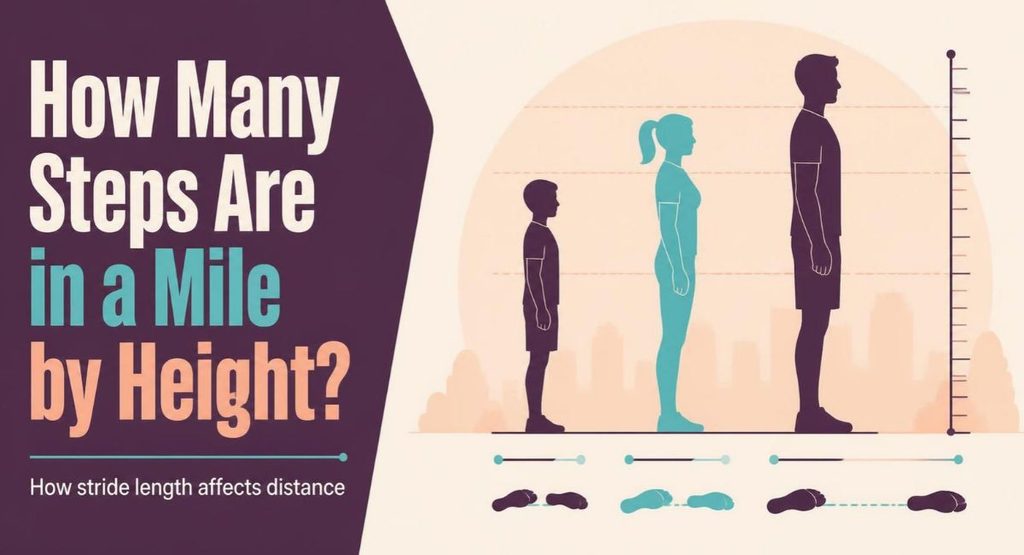
Height is one of the factors that can help estimate your steps per mile. Taller people generally have longer legs and may cover more ground with each step. Shorter people often take more steps to travel the same distance.
The following table provides approximate walking estimates for adults of different heights.
| Height | Estimated steps per mile |
| 5 feet 0 inches | 2,500 to 2,600 |
| 5 feet 2 inches | 2,400 to 2,500 |
| 5 feet 4 inches | 2,300 to 2,400 |
| 5 feet 6 inches | 2,250 to 2,350 |
| 5 feet 8 inches | 2,150 to 2,250 |
| 5 feet 10 inches | 2,100 to 2,200 |
| 6 feet 0 inches | 2,000 to 2,150 |
| 6 feet 2 inches | 1,950 to 2,100 |
| 6 feet 4 inches | 1,900 to 2,050 |
These ranges are general estimates, not exact measurements for everyone at a particular height. Two people of the same height can have different stride lengths, walking speeds, and step counts.
For example: A person who is 5 feet 2 inches tall might take around 2,450 steps to walk a mile, while a person who is 6 feet tall might need around 2,100. Both can cover exactly the same distance.
Use your height as a starting point, then measure your actual walking steps for a more reliable estimate.
How Many Steps Are in a Mile When Running?

Running a mile often takes fewer steps than walking one because running usually involves a longer stride. Many recreational runners take approximately 1,400 to 2,000 steps per mile, although individual results vary.
Your running speed can change the number of steps you need. Faster running often involves a longer stride, but some runners increase their step rate instead. Running technique, fitness, leg length, and terrain all play a role.
| Activity | Approximate steps per mile |
| Slow walking | 2,200 to 2,600 |
| Comfortable walking | 2,000 to 2,400 |
| Brisk walking | 1,900 to 2,200 |
| Easy jogging | 1,700 to 2,000 |
| Running | 1,400 to 1,800 |
These ranges overlap because people move differently at the same speed. They should be used as general guides rather than strict targets.
If you’re training for a race, your watch or running app can help you compare step counts across different runs. Don’t worry if your count differs from someone else’s. A lower number does not automatically mean that your running form is better.
What Factors Affect the Number of Steps in a Mile?
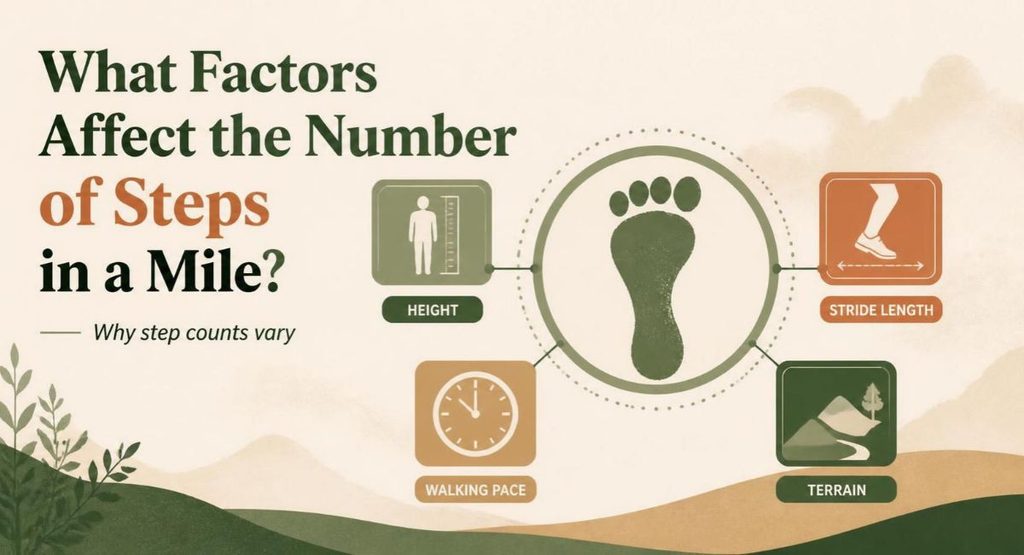
Several things influence how many steps you take to cover one mile. Understanding them can explain why your fitness tracker sometimes shows a different count from someone else’s device.
1. Stride Length
Stride length is one of the biggest factors. In everyday step-count estimates, people often use the term to describe the distance covered with each step.
If each step covers 2 feet, you’ll need more steps to cover a mile than someone whose step covers 2.5 feet.
For example:
- A 2-foot step requires 2,640 steps per mile.
- A 2.2-foot step requires 2,400 steps per mile.
- A 2.5-foot step requires about 2,112 steps per mile.
- A 2.75-foot step requires about 1,920 steps per mile.
This is why measuring your step length can provide a better estimate than relying on an average.
2. Walking Speed
Your pace can change your natural step length and step rate. Many people take longer steps when walking briskly, which can reduce the number of steps needed to cover a mile.
Still, speed does not affect everyone in exactly the same way. Some people walk faster mainly by taking more steps per minute rather than making each step much longer.
3. Age and Mobility
Age can influence walking patterns, but it doesn’t determine your step count on its own. Some older adults take shorter steps because of changes in balance, strength, joint movement, or mobility. Others maintain a long, comfortable stride.
Your usual movement pattern is more useful than making assumptions based on age alone.
4. Terrain and Walking Conditions
Walking uphill, crossing uneven ground, or following a winding trail may change your stride. You might take shorter steps to maintain balance or navigate obstacles.
A mile on a flat running track can therefore produce a different step count from a mile on a hilly hiking trail.
5. Walking Versus Running
Walking and running use different movement patterns. Running generally allows a person to cover more distance per step, although running step counts vary widely with speed and technique.
For the most accurate estimate, use a separate measurement for your normal walk and your usual run.
Read Also: 2 Feet Tall Object
How to Calculate Your Own Steps Per Mile
You can estimate your personal steps per mile without buying special equipment. All you need is a measured distance and a way to count your steps.
Follow these steps:
- Find a flat route with a known distance, such as a measured track or a clearly marked section of a walking path.
- Walk at your normal pace for that distance.
- Count each step using a phone, smartwatch, pedometer, or manual count.
- Divide the number of steps by the distance in miles.
- Repeat the test and average the results to reduce small counting errors.
For example, suppose you walk half a mile and take 1,120 steps.
Your estimated steps per mile would be:
1,1202=2,240
That means your estimated walking count is 2,240 steps per mile.
You can use this figure to estimate how many miles you walk from your daily step total. If you record 6,720 steps, for example, you would have walked approximately 3 miles, assuming those steps reflect your usual walking pattern.
How to Measure Your Step Length
You can also measure how far you travel with each step.
Walk a known distance, such as 100 feet, at your regular pace. Count your steps, then divide the distance by the number of steps.
Suppose you cover 100 feet in 45 steps.
100452.22feet
Your average step length is approximately 2.22 feet.
To estimate your steps per mile, divide 5,280 feet by your step length:
5,2802.222,378
Your estimated total is about 2,378 steps per mile.
For a more reliable measurement, repeat the test a few times and use your average step length. Measure your walking stride separately from your running stride because the two may differ considerably.
How Many Miles Is 10,000 Steps?
For many adults, 10,000 steps equal approximately 4 to 5 miles of walking. The exact distance depends on how long each step is.
If your average step length is about 2.5 feet, 10,000 steps cover approximately 4.73 miles. With shorter steps, you may cover closer to 4 miles. With longer steps, you may travel farther.
Here is a simple conversion chart.
| Step count | Estimated distance |
| 1,000 steps | 0.4 to 0.5 miles |
| 2,000 steps | 0.8 to 1 mile |
| 3,000 steps | 1.2 to 1.5 miles |
| 4,000 steps | 1.6 to 2 miles |
| 5,000 steps | 2 to 2.5 miles |
| 6,000 steps | 2.4 to 3 miles |
| 8,000 steps | 3.2 to 4 miles |
| 10,000 steps | 4 to 5 miles |
| 12,000 steps | 4.8 to 6 miles |
| 15,000 steps | 6 to 7.5 miles |
| 20,000 steps | 8 to 10 miles |
These are approximate conversions for walking, not exact distances. Your personal step length determines where you fall within each range.
Is 10,000 Steps a Day Necessary?
No. Ten thousand steps is a popular daily target, but it isn’t a universal requirement for good health. Your appropriate activity level depends on your current fitness, health, age, and personal goals.
If you’re currently taking 3,000 steps per day, you don’t have to jump straight to 10,000. Start with a manageable increase and build your walking routine gradually.
You can also divide your walking into smaller sessions. A short walk in the morning, a few minutes during lunch, and an evening stroll can all contribute to your daily total.
The most useful goal is one that encourages regular movement and fits your lifestyle.
How Long Does It Take to Walk a Mile?
At a comfortable walking pace, many adults can walk one mile in approximately 15 to 25 minutes. Your walking speed, terrain, and fitness level will affect the time.
A brisk walker may finish in less time, while someone taking a leisurely stroll may need longer.
| Walking pace | Approximate time per mile |
| Leisurely walk | 25 to 30 minutes |
| Comfortable walk | 20 to 25 minutes |
| Moderate walk | 17 to 20 minutes |
| Brisk walk | 15 to 17 minutes |
| Very fast walk | 13 to 15 minutes |
These times are general estimates, not fixed speed categories. Hills, traffic lights, crowded sidewalks, and rest breaks can increase the time needed.
Your step count and walking time measure different things. Two people might complete a mile in 20 minutes but record different numbers of steps because their strides are different.
If you’re trying to improve your walking fitness, track your distance and time alongside your step count. Together, these measurements give you a clearer picture of your activity.
How Accurate Are Phone and Smartwatch Step Counters?
Phones, smartwatches, and fitness bands can estimate your daily steps, but their readings aren’t always exact. They use movement sensors and algorithms to identify patterns that resemble walking or running.
Accuracy may change depending on how you carry your phone, wear your watch, and move your arms. Some devices may miss steps during slow walking or count certain movements as steps when they aren’t.
For example, a phone left on a desk won’t record your walking around the house. A watch may record movement differently when you’re pushing a shopping cart because your arm stays relatively still.
To get more consistent results:
- Carry your phone in a consistent location when practical.
- Wear your smartwatch as recommended by its manufacturer.
- Compare your device with a measured walking route.
- Use the same device when comparing your daily totals.
- Treat small differences as normal rather than assuming the tracker is broken.
If your tracker says you’ve walked 2,300 steps during a mile, that can be a reasonable result. The important thing is to understand that step counters provide estimates, not laboratory measurements.
Frequently Asked Questions
How many steps are in a mile for the average person?
Most adults take approximately 2,000 to 2,500 steps to walk one mile. A useful estimate is 2,200 steps, but your height, stride length, walking speed, and terrain can change the total.
Is 2,000 steps equal to one mile?
About 2,000 steps can equal one mile for someone with a relatively long walking stride. People with shorter steps may need 2,300 or more steps to cover the same distance.
How many steps are in a mile for a 5-foot person?
A person who is 5 feet tall might take approximately 2,500 to 2,600 steps to walk a mile. This is a general estimate, and the actual number depends on their stride length and walking pace.
How many steps are in a mile for a 6-foot person?
A person who is 6 feet tall might take around 2,000 to 2,150 walking steps per mile. Height alone cannot determine an exact count, so measuring a known distance provides a better estimate.
How many steps does it take to run a mile?
Many runners take approximately 1,400 to 2,000 steps per mile. Faster running and longer strides can reduce the count, but running technique and individual movement patterns also matter.
How many steps are in half a mile?
Walking half a mile usually takes about 1,000 to 1,250 steps for an average adult. Your personal total may be lower or higher depending on your stride length.
How many steps are in 5 miles?
Walking five miles generally takes around 10,000 to 12,500 steps. If your average walking step is 2.5 feet long, you would need about 10,560 steps to cover five miles.
Can I calculate miles from my daily step count?
Yes. Divide your daily steps by your estimated steps per mile. For example, if you take 8,800 steps and average 2,200 steps per mile, you’ve covered approximately 4 miles.
Conclusion
So, how many steps are in a mile? For most adults, walking one mile takes approximately 2,000 to 2,500 steps. Your exact count depends on your height, stride length, walking speed, and the surface you’re walking on. Running usually requires fewer steps because runners often cover more ground with each step.
If you want a more accurate estimate, measure your steps over a known distance and calculate your personal average. You can then use that number to convert daily steps into miles and set realistic walking goals.
Remember, you don’t need to reach 10,000 steps every day to make progress. Start with a comfortable goal, stay consistent, and increase your activity gradually. The best step target is one that supports your fitness goals and fits comfortably into your daily routine.

Ezra Holden is a measurement focused writer at Classy Valve, sharing practical insights on units, dimensions, conversions, calculations, and measurement concepts. With a research driven approach, Ezra focuses on clear explanations, accurate examples, and useful guidance that helps readers understand technical measurement topics with greater confidence.