

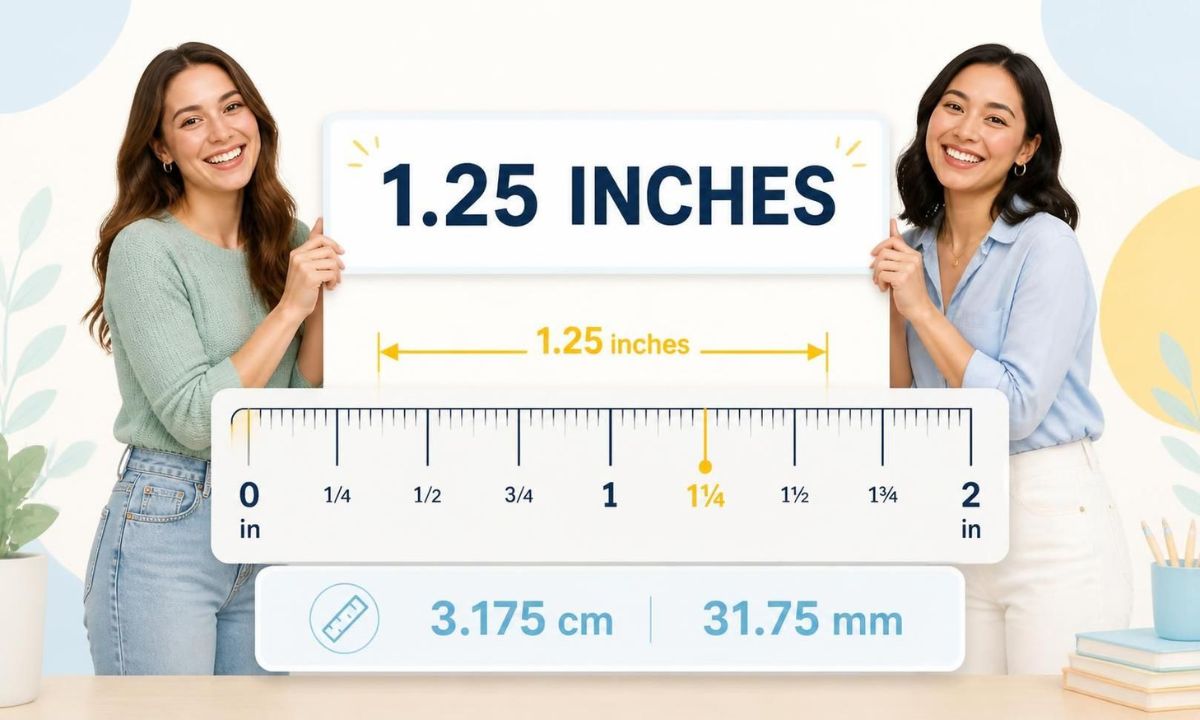
Understanding small measurements can sometimes be tricky, especially when you don’t have a ruler nearby. If you’re wondering how big 1.25 inches is, it’s slightly longer than one inch. This measurement is equal to 1¼ inches, 3.175 centimeters, or 31.75 millimeters. Although it sounds small, you can find similar measurements in everyday objects, household items, clothing accessories, and small hardware.
Knowing what 1.25 inches looks like can help when shopping online, working on DIY projects, measuring objects, or following product specifications. You don’t always need a measuring tape to understand its size. Comparing it with familiar objects can make the measurement easier to visualize.
In this guide, you’ll learn how big 1.25 inches is on a ruler, how to convert it into other units, and which everyday objects can help you picture this length.
What Does 1.25 Inches Mean?
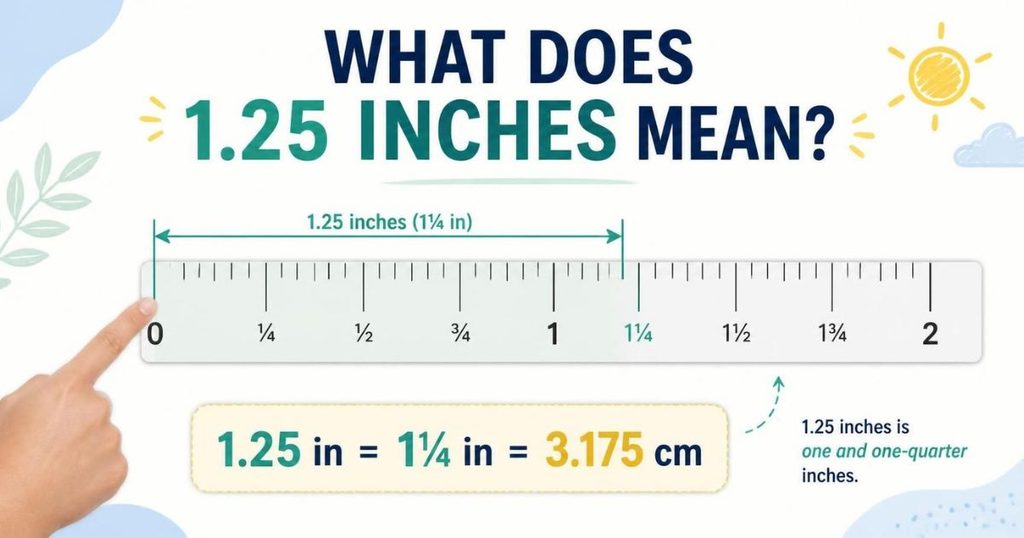
1.25 inches means one whole inch plus one-quarter of another inch. It is also written as 1¼ inches or five-quarters of an inch.
In decimal form, the measurement is 1.25 inches. The number after the decimal point represents an additional quarter inch.
Here’s a simple breakdown:
- 1 whole inch = 1.00 inch
- ¼ inch = 0.25 inch
- Total = 1.25 inches
This measurement is commonly used when describing small objects, hardware, clothing accessories, and craft materials.
How Big Is 1.25 Inches on a Ruler?
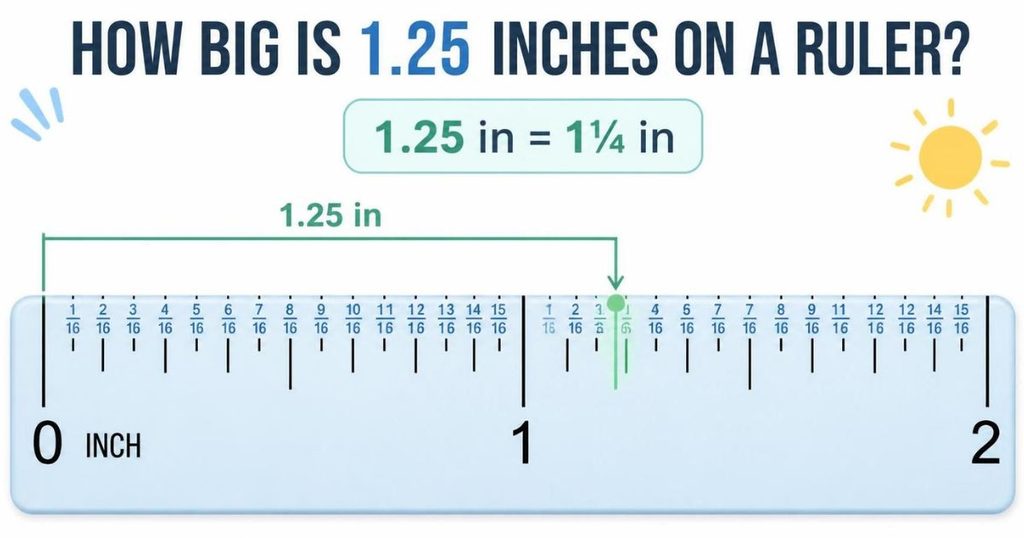
On a standard inch ruler, 1.25 inches is the first quarter-inch mark after the one-inch line.
To locate it, follow these steps:
- Find the zero mark on your ruler.
- Locate the one-inch mark.
- Look at the smaller measurement lines after one inch.
- Find the first quarter-inch mark.
- That mark represents 1.25 inches.
Most standard rulers divide each inch into smaller sections, such as halves, quarters, eighths, and sixteenths.
Since one-quarter inch equals 0.25 inches, adding it to one whole inch gives you exactly 1.25 inches.
Remember: 1.25 inches is not halfway between one and two inches. It is only one-quarter of the way past the one-inch mark.
How Big Is 1.25 Inches in CM, MM, and Other Units?
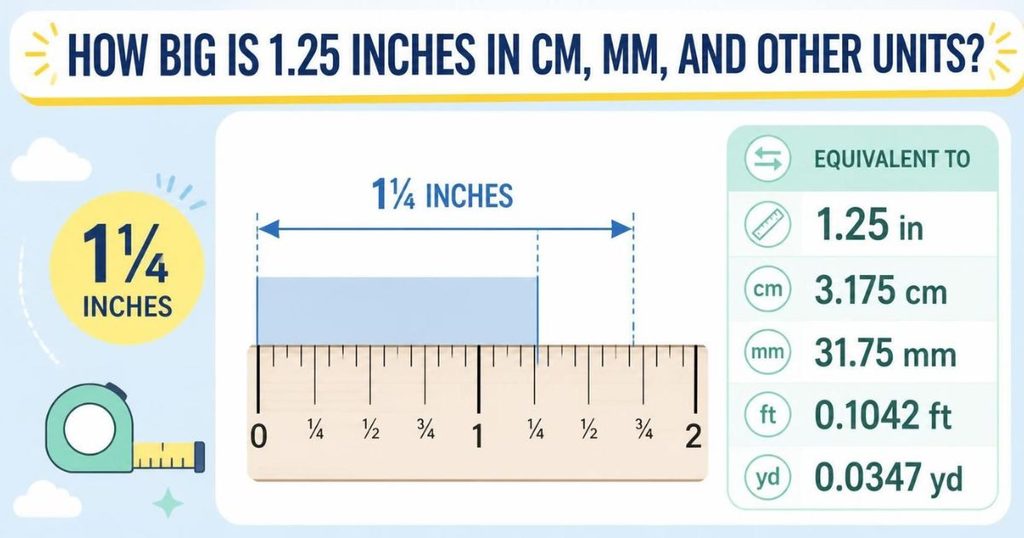
Converting 1.25 inches into metric units makes the measurement easier to understand, especially if you normally use centimeters or millimeters.
One inch equals exactly 2.54 centimeters. Multiply 1.25 by 2.54 to calculate the centimeter measurement.
1.25 × 2.54 = 3.175 cm
Here are the most useful conversions:
| Measurement unit | Equivalent size |
| Inches | 1.25 inches |
| Fraction | 1¼ inches |
| Centimeters | 3.175 cm |
| Millimeters | 31.75 mm |
| Meters | 0.03175 m |
| Feet | 0.10417 ft |
| Yards | 0.03472 yd |
1.25 Inches in Centimeters
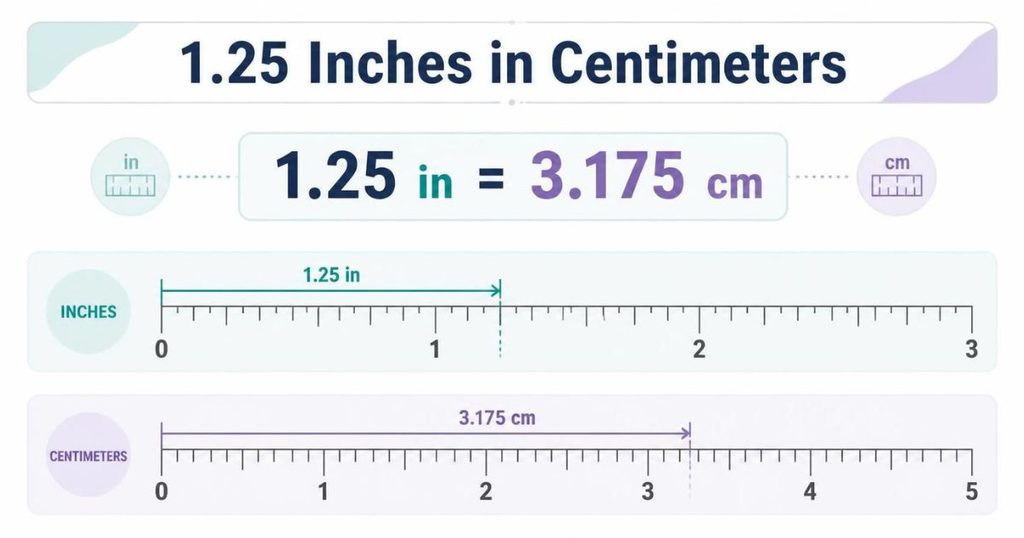
1.25 inches equals 3.175 centimeters. For everyday use, you can round this measurement to approximately 3.18 cm.
This conversion is helpful when shopping for products that list their dimensions in centimeters. It is also useful for school assignments, sewing projects, and small household measurements.
1.25 Inches in Millimeters
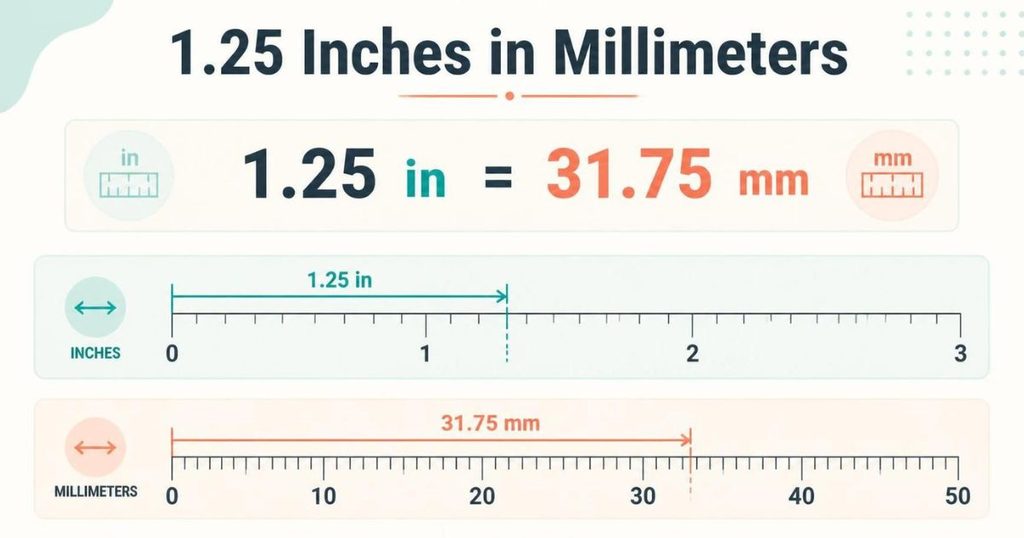
There are 25.4 millimeters in one inch. Therefore, 1.25 inches equals 31.75 millimeters.
Millimeters are especially useful when measuring small parts, screws, buttons, electronic components, and craft materials.
1.25 Inches in Feet
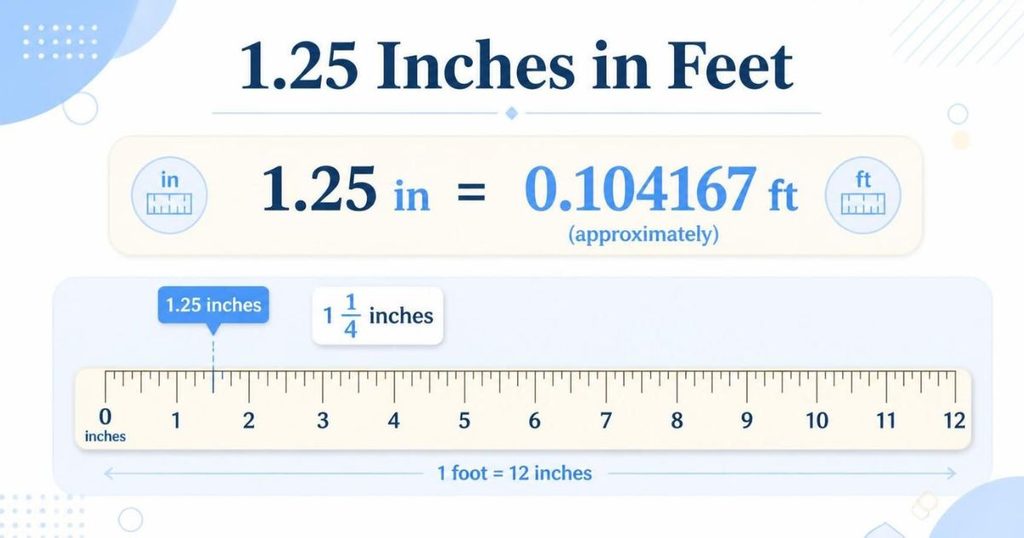
One foot contains 12 inches. To convert 1.25 inches into feet, divide 1.25 by 12.
The result is approximately 0.1042 feet.
This is a little more than one-tenth of a foot, showing how short the measurement is compared with a full foot.
What Does 1.25 Inches Look Like in Real Life?
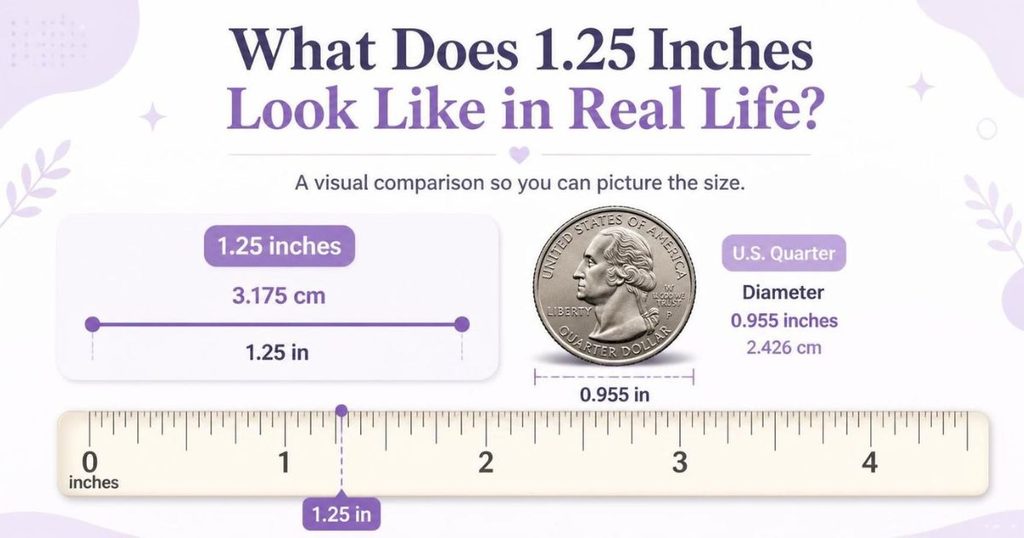
Numbers and conversion charts are helpful, but familiar objects can make a measurement easier to picture. A length of 1.25 inches is small enough to fit comfortably in your hand.
Here are some everyday comparisons that can help you visualize this measurement.
1. A Standard 2-by-4 LEGO Brick
A standard 2-by-4 LEGO brick is approximately 1.25 inches long along its longer side. This makes it a convenient physical reference when trying to imagine this measurement.
If you have a traditional LEGO brick nearby, look at its longer edge. Its length gives you a useful idea of what 1.25 inches looks like.
Keep in mind that different LEGO pieces have different dimensions, so this comparison applies to the standard 2-by-4 brick.
2. A Large Clothing Button
Some large coat and jacket buttons measure around 1.25 inches across. Their circular shape makes them a simple comparison for understanding a short measurement.
Look at a large button on a winter coat or jacket. Measure across its widest point, from one edge to the opposite edge, to see whether it is close to 1.25 inches.
Button sizes vary depending on the clothing style, so not every large button will have this exact diameter.
3. A Bottle Cap
A bottle cap can provide another familiar size reference. Some larger beverage caps measure close to 1.25 inches across, although the exact diameter depends on the bottle and cap design.
Place the cap on a flat surface and measure across its widest circular section. This will help you compare its diameter with 1.25 inches.
4. A Small Binder Ring
A small binder ring is another useful office-related comparison. Some rings have an outside diameter close to 1.25 inches.
You can find these rings in stationery supplies, folders, and craft materials. Their round shape makes them easy to compare with a ruler.
Remember to measure the outside diameter rather than the opening inside the ring.
5. A Small Wood Screw
A 1.25-inch wood screw provides an exact example of this length when its measurement refers to the screw’s specified length.
These screws are used in different woodworking and household projects. Their length can be useful when attaching small pieces of wood or working with furniture.
When measuring a screw, check its head style because the way screw length is specified can vary. For many common flat-head wood screws, the length includes the head.
Is 1.25 Inches Considered Big or Small?
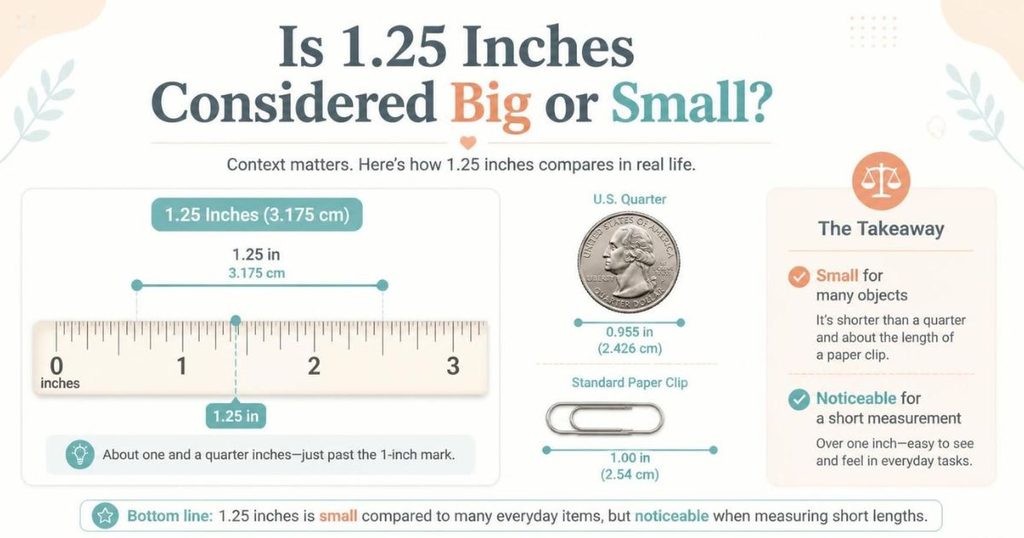
1.25 inches is generally considered a small measurement. It is only one-quarter inch longer than a standard inch, so it is not a particularly large distance.
However, whether it is big or small depends on what you are measuring.
For example, 1.25 inches can be a reasonable diameter for a large clothing button. It may also be a useful length for a small screw, but it would be very short for a ruler, table edge, or furniture component.
Here is a simple comparison:
| Measurement | Size |
| ¼ inch | 0.25 inches |
| ½ inch | 0.50 inches |
| ¾ inch | 0.75 inches |
| 1 inch | 1.00 inch |
| 1¼ inches | 1.25 inches |
| 1½ inches | 1.50 inches |
| 2 inches | 2.00 inches |
As you can see, 1.25 inches is larger than one inch but smaller than one and a half inches.
How to Measure 1.25 Inches Without a Ruler
You do not always need a ruler or measuring tape to estimate a small distance. Several everyday objects can help you visualize 1.25 inches.
Here are a few practical methods.
Use a LEGO Brick
A standard 2-by-4 LEGO brick is approximately 1.25 inches long. If you have one at home, use its longer side as a reference.
This is one of the more convenient comparisons because the brick has a consistent manufactured size.
Use a Large Button
Find a large button on a coat or jacket. If its diameter is close to 1.25 inches, it can help you estimate the measurement.
This method is useful for quick comparisons, although button sizes are not standardized across all clothing.
Compare It With Your Thumb
Your thumb can give you a rough visual estimate. Some adults have a thumb width close to one inch, but hand sizes vary considerably.
If your thumb is approximately one inch wide, imagine adding another quarter inch to its width.
This is not a precise measuring technique, but it can help you understand the general size.
Use a Bank Card for Perspective
A standard bank card is approximately 3.37 inches wide. Since 1.25 inches is considerably shorter, you can imagine a little more than one-third of the card’s width.
This is a useful way to picture the measurement without needing a ruler.
For accurate work, always use a properly calibrated measuring tool rather than relying on visual estimates.
Read Also: How Long Is 15 Feet? 12 Familiar Objects
Where Is a 1.25-Inch Measurement Commonly Used?
Although 1.25 inches is a relatively short distance, it can appear in several practical situations.
Home Improvement and Woodworking
Small measurements are important when working with wood, furniture, and household repairs.
A 1.25-inch screw may be used in certain woodworking projects, depending on the thickness of the materials and the type of connection required.
Other hardware components, including small spacers and fittings, may also have dimensions around this size.
Sewing and Clothing
Clothing accessories come in different sizes, and some large buttons have diameters close to 1.25 inches.
This measurement can also help when planning decorative details, measuring fabric sections, or choosing suitable craft materials.
Arts and Crafts
People who enjoy making handmade decorations often work with small measurements.
A 1.25-inch piece may be suitable for certain decorative shapes, labels, small ornaments, and craft components.
Accurate measurements can help keep handmade projects consistent.
Toys and Building Materials
Small building pieces are another place where this measurement is useful.
A standard 2-by-4 LEGO brick is approximately 1.25 inches long. Knowing its dimensions can help when comparing building pieces or planning small construction projects.
Jewelry and Accessories
Some jewelry components, decorative pendants, and accessory pieces have dimensions close to 1.25 inches.
This measurement can help when comparing product specifications before purchasing an item.
Always check whether the listed size refers to the length, width, diameter, or total height of the product.
How Much Longer Is 1.25 Inches Than 1 Inch?
1.25 inches is exactly 0.25 inches longer than one inch.
A quarter inch may sound like a very small difference, but it can matter when accuracy is important.
For example, a screw that is 1.25 inches long is longer than one that is exactly one inch. Similarly, a button with a 1.25-inch diameter is wider than a button with a one-inch diameter.
The difference can also be expressed in other units:
- 0.25 inches
- 6.35 millimeters
- 0.635 centimeters
This means that 1.25 inches is one-quarter inch, or 6.35 millimeters, longer than one inch.
How to Write 1.25 Inches Correctly
There are several ways to write this measurement. Each form represents the same length.
| Format | Correct measurement |
| Decimal | 1.25 inches |
| Fraction | 1¼ inches |
| Fraction with slash | 1 1/4 inches |
| Abbreviation | 1.25 in |
| Millimeters | 31.75 mm |
| Centimeters | 3.175 cm |
The decimal form is common in product descriptions, technical specifications, and digital measurements.
The fractional form is often used on traditional rulers, tape measures, and woodworking plans.
Both forms are correct. Choose the one that makes the measurement easiest to understand in your particular situation.
Common Mistakes When Measuring 1.25 Inches
Small measurements can be confusing, especially when you are working with decimal numbers and fractions. Here are some mistakes to avoid.
Confusing 1.25 Inches With 1.5 Inches
These measurements are not the same.
- 1.25 inches equals 1¼ inches.
- 1.5 inches equals 1½ inches.
The difference is 0.25 inches, or one-quarter inch.
Starting From the Wrong Ruler Mark
Always begin measuring from the zero mark, not the edge of the ruler. Some rulers have a small blank space before the first measurement line.
If you start from the physical edge instead of zero, your result may be inaccurate.
Mixing Inches and Centimeters
Inches and centimeters use different measurement systems. A measurement of 1.25 inches is not the same as 1.25 centimeters.
Always check the unit printed on your ruler or measuring tape before taking a measurement.
Rounding Too Early
The exact metric conversion is 3.175 centimeters, not exactly 3.18 centimeters. Although rounding to 3.18 cm is fine for everyday comparisons, keep the full value when working on a project that requires greater accuracy.
Frequently Asked Questions
How big is 1.25 inches in real life?
1.25 inches is a little longer than one inch. It is approximately the length of a standard 2-by-4 LEGO brick and equals 3.175 centimeters.
Is 1.25 inches the same as 1¼ inches?
Yes. Both measurements represent exactly the same length. The decimal form is 1.25 inches, while the fractional form is 1¼ inches.
How many centimeters are in 1.25 inches?
There are exactly 3.175 centimeters in 1.25 inches. For everyday measurements, you can round this value to 3.18 centimeters.
How many millimeters is 1.25 inches?
1.25 inches equals exactly 31.75 millimeters. You can calculate this by multiplying 1.25 by 25.4.
Where is 1.25 inches on a ruler?
Look for the first quarter-inch mark after the one-inch line. It is located between the 1-inch and 1½-inch marks.
Is 1.25 inches bigger than 1 inch?
Yes. It is exactly one-quarter inch longer than one inch, which equals an additional 6.35 millimeters.
What everyday object is approximately 1.25 inches long?
A standard 2-by-4 LEGO brick is approximately 1.25 inches long. Some large clothing buttons and bottle caps may also have dimensions close to this measurement.
How do I measure 1.25 inches without a measuring tape?
You can use a standard 2-by-4 LEGO brick as a visual reference or compare the distance with a large clothing button. These methods provide estimates, but a ruler is better for accurate measurements.
Is 1.25 inches close to 3 centimeters?
Yes. It is slightly longer than 3 centimeters. The exact measurement is 3.175 centimeters, which is 0.175 centimeters more than 3 cm.
What is half of 1.25 inches?
Half of 1.25 inches is 0.625 inches, which is equal to ⅝ of an inch or 15.875 millimeters.
Conclusion
So, how big is 1.25 inches? It measures exactly 1¼ inches, 3.175 centimeters, or 31.75 millimeters. It is a small measurement that is easy to locate on a standard ruler by finding the first quarter-inch mark after the one-inch line.
You can also picture it using familiar items, such as a standard 2-by-4 LEGO brick or a large clothing button. Whether you are measuring household objects, working on a craft project, or checking product dimensions, understanding this measurement makes comparisons much easier. For the most accurate results, use a ruler or measuring tape and remember that 1.25 inches is slightly longer than one inch.

Ezra Holden is a measurement focused writer at Classy Valve, sharing practical insights on units, dimensions, conversions, calculations, and measurement concepts. With a research driven approach, Ezra focuses on clear explanations, accurate examples, and useful guidance that helps readers understand technical measurement topics with greater confidence.