

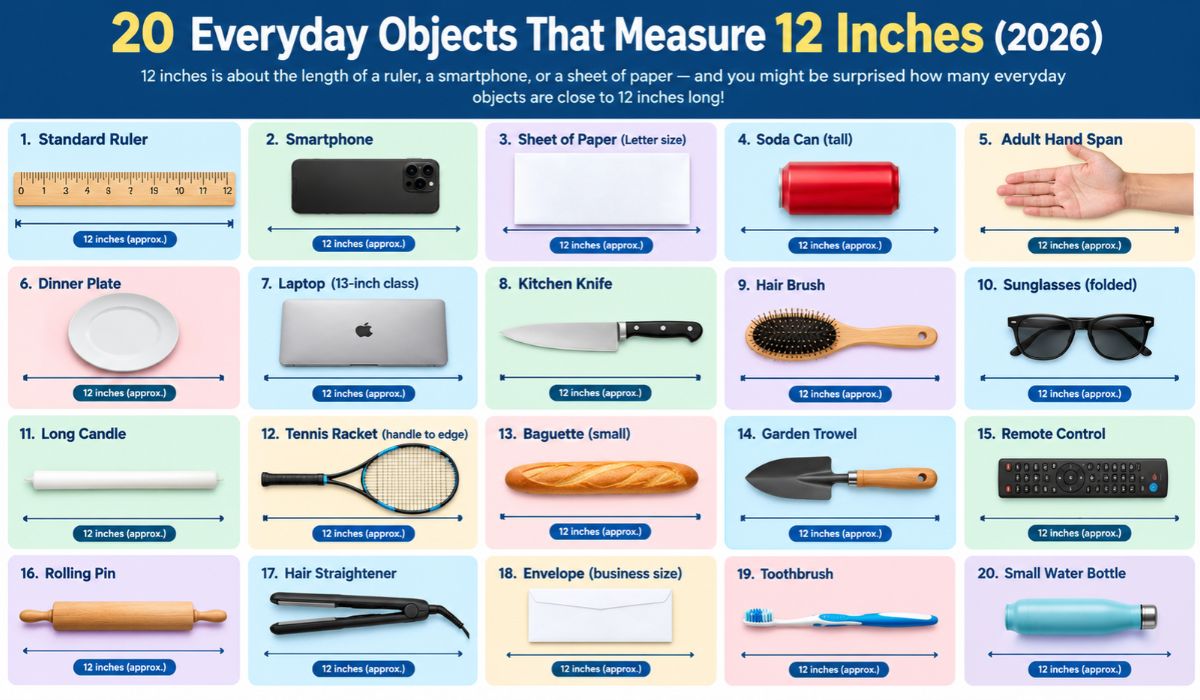
Have you ever wondered how long 12 inches really is? It equals one foot, but picturing that length can be tricky when you don’t have a ruler or measuring tape nearby. Luckily, many everyday objects can help you visualize it.
From household items to school supplies and common accessories, several familiar things are around 12 inches long. In this guide, we’ll explore 17 everyday objects that measure about 12 inches, giving you simple real-life comparisons to understand this length. Keep in mind that sizes can vary by brand and design, so these examples are approximate rather than exact measurements.
12 Inches Compared To Human
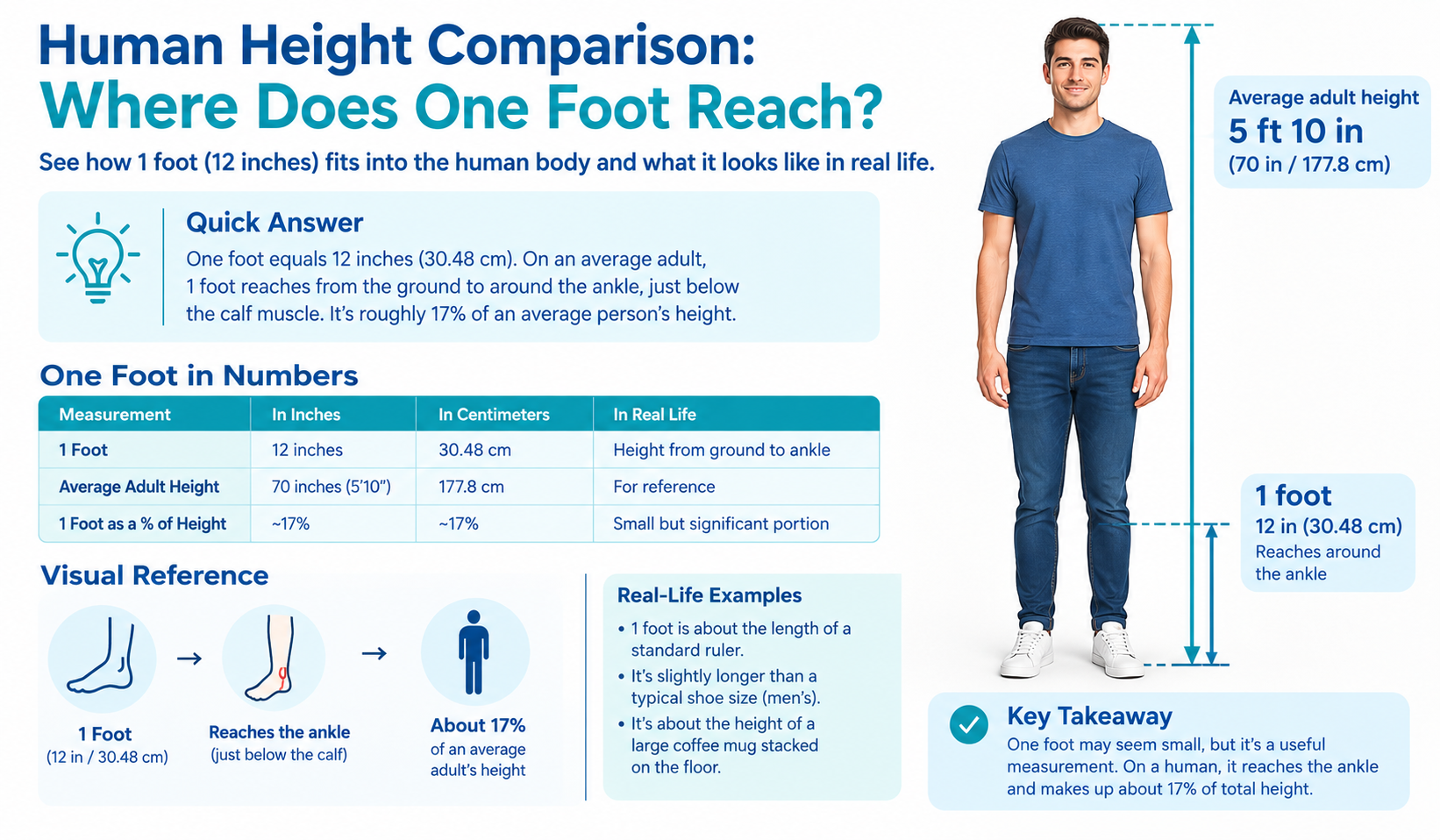
Twelve inches equals exactly one foot, or 30.48 centimeters. Compared with a person, it is roughly the length of some adults’ forearms from wrist to elbow, but body proportions vary. If you imagine a standing adult, one foot is only a small section of their height—about one-sixth of a six-foot person.
| At a glance | Measurement or comparison |
| Exact length | 12 inches |
| Feet | 1 foot |
| Centimeters | 30.48 cm |
| Millimeters | 304.8 mm |
| Meters | 0.3048 m |
| Human-body reference | A forearm may be close, but measure your own |
| Best exact visual aid | A verified 12-inch ruler or tape measure |
| Important caution | Anatomy and everyday objects vary |
Figure 1. Visual guide to one foot in relation to a person, forearm length, and a ruler. The body example is illustrative; it is not a universal anatomical measurement.
What Does 12 Inches Look Like?
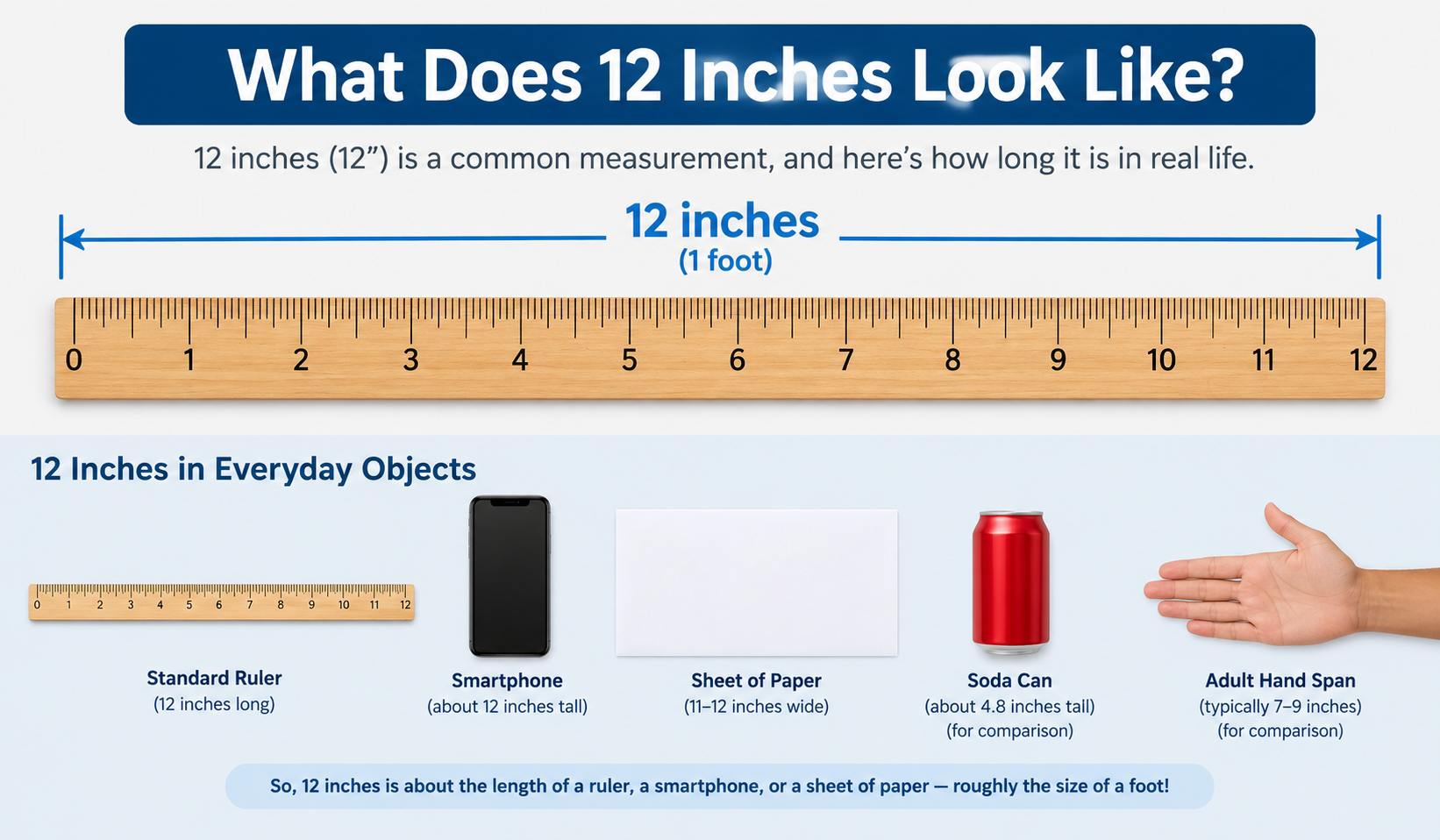
Twelve inches is the length of one foot. It is long enough to be obvious in your hand, yet short compared with a full human body, a doorway, or a typical adult’s total height. The easiest way to picture it is to imagine a standard school ruler laid flat on a desk.
If you do not have a ruler nearby, think of a familiar object that is close to a foot long, such as a large tablet’s long edge, a small kitchen tool, or a forearm. These comparisons are useful for visualization, but only a ruler or tape measure confirms the exact distance.
Read Also This: Objects For Every One That Measure 4 Inches
Why the measurement feels different in different contexts
A 12-inch line can seem long when you hold it beside a phone, but small when you compare it with your height. The length itself never changes; your reference point changes. A circular 12-inch pizza pan also looks different from a straight 12-inch ruler because the pan measures 12 inches across its diameter, not along its curved rim.
The word “compared” matters here. A person might ask how 12 inches looks on a body, how much of a person’s height it represents, or which body part is near that length. These are three different questions, and each needs a slightly different answer.
| Question | Best way to picture it | Accuracy |
| How long is 12 inches? | 12-inch ruler or tape measure | Exact when tool is accurate |
| What body part is near 12 inches? | Your own wrist-to-elbow distance | Approximate |
| How much of a person’s height is it? | Compare with total height in inches | Exact if height is known |
| What household item is 12 inches? | Check the item’s stated dimensions | Varies by item |
12 Inches in Feet, Centimeters, and Other Units
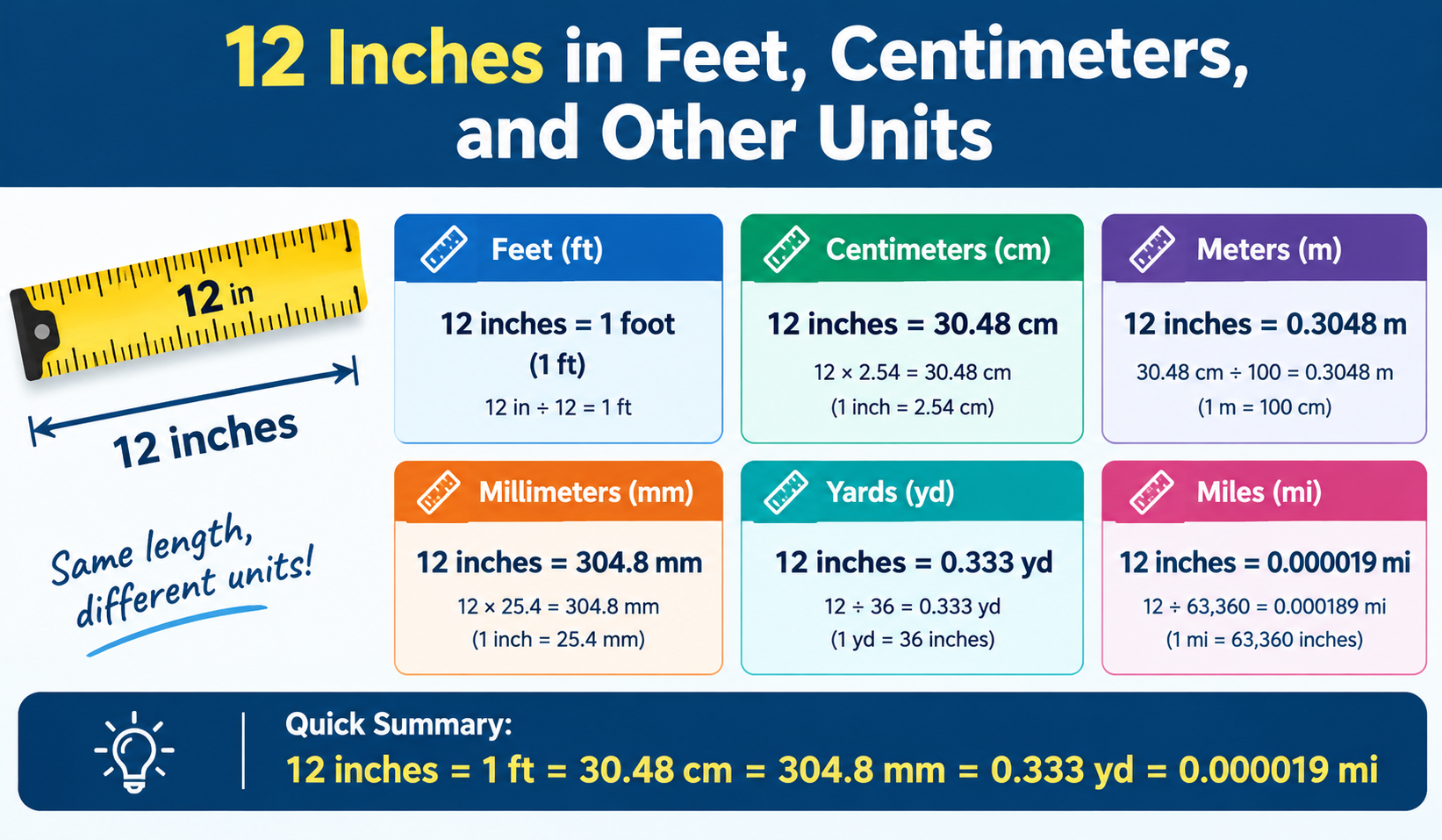
The conversion is exact: 12 inches equals one foot. In the metric system, one inch is defined as 2.54 centimeters, so 12 multiplied by 2.54 gives 30.48 centimeters. That is also 304.8 millimeters or 0.3048 meters.
If you live in a country where centimeters and meters are used more often, remember that 30.48 cm is just over 30 centimeters. For quick mental estimation, “about 30 cm” is convenient; for buying materials, cutting wood, tailoring, or fitting equipment, use the exact 30.48 cm conversion.
| Unit | Equivalent to 12 inches | When it helps |
| Inches | 12 in | Imperial product listings and rulers |
| Feet | 1 ft | Room dimensions and construction |
| Centimeters | 30.48 cm | Metric measurements and online shopping |
| Millimeters | 304.8 mm | Technical drawings and precise fitting |
| Meters | 0.3048 m | Metric calculations |
| Yards | 0.3333 yd (one-third yard) | Fabric and larger distances |
| Kilometers | 0.0003048 km | Rarely useful at this scale |
| Miles | 0.0001894 mi approximately | Rarely useful at this scale |
Simple conversion formulas
· Inches to centimeters: multiply inches by 2.54.
· Centimeters to inches: divide centimeters by 2.54.
· Inches to feet: divide inches by 12.
· Feet to inches: multiply feet by 12.
For example, 18 inches ÷ 12 = 1.5 feet. Likewise, 30 centimeters ÷ 2.54 is about 11.81 inches, which is slightly shorter than one foot. These quick calculations help you compare measurements listed in different units without mixing up inches, centimeters, and feet.
How 12 Inches Compares With the Human Body
The human body gives you a convenient visual reference, but it is not a standardized measuring instrument. Adults differ in height, arm length, hand size, age, and body proportions. Even a person’s left and right sides may not match perfectly.
Forearm: wrist to elbow
The forearm is one of the most useful body-based comparisons for 12 inches. To check it, bend your arm slightly and measure from the wrist crease toward the point of the elbow, following the straight line along the forearm. Depending on your build and where you start and stop, this distance may be close to a foot, shorter than a foot, or longer.
Do not assume every adult’s forearm is 12 inches. The measurement can differ substantially across people, and online statements that assign one universal forearm length to all men or all women are too broad to use as a reliable rule. Your own measurement is the relevant one if you want to use your body as a rough reference.
Hand span
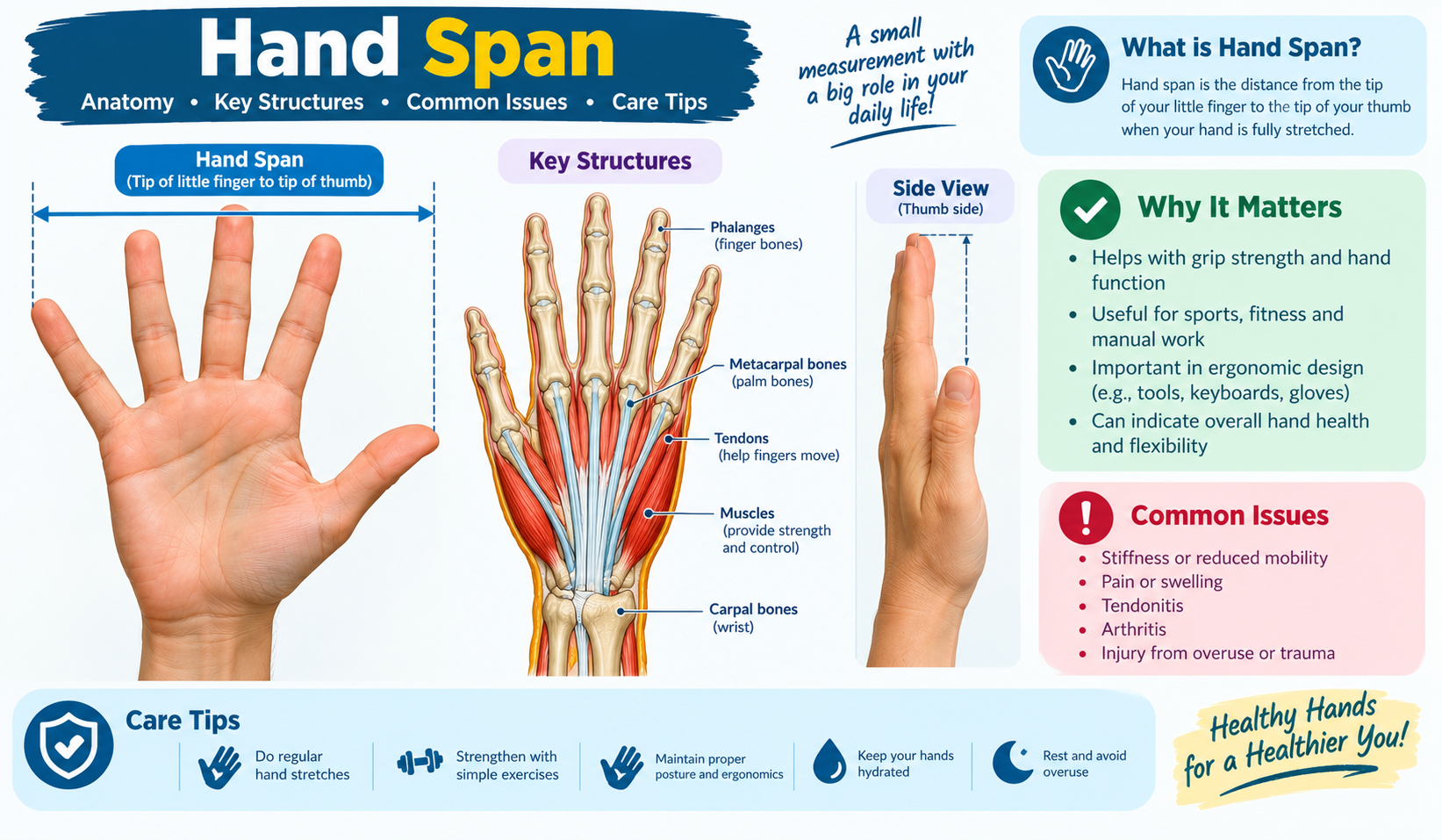
A hand span usually means the distance from the tip of the thumb to the tip of the little finger when the hand is spread wide. For many people, a single hand span is shorter than 12 inches. Two spans placed end to end may approximate a foot, but there is no guarantee that the total will be exact because hand sizes vary.
If you use your hand, keep your fingers fully extended and repeat the span consistently. Do not measure one span with the fingers spread widely and the next with a relaxed hand. Consistency makes the estimate more useful, even if it is not precise.
Foot length
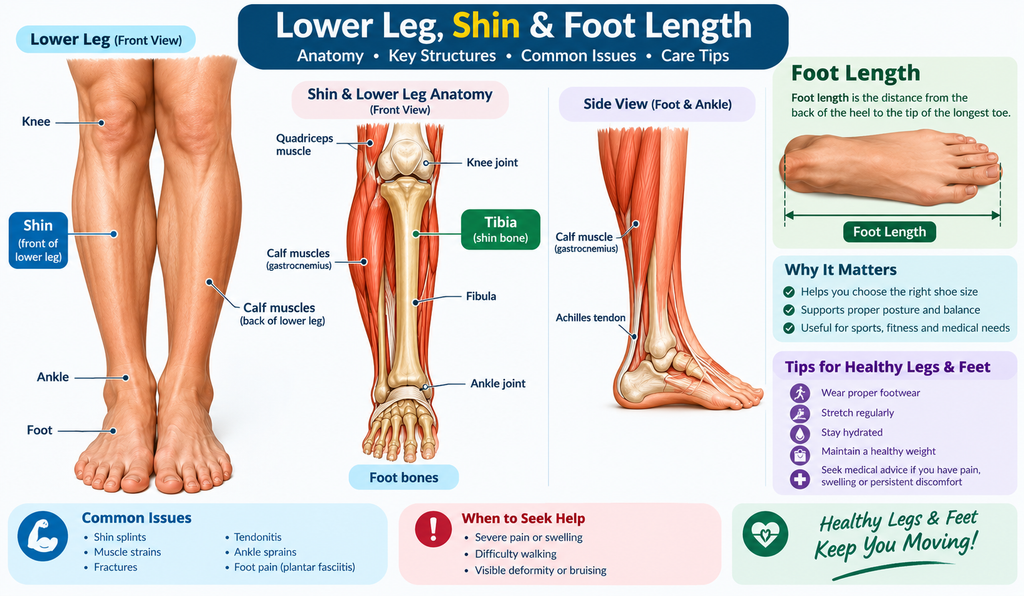
The name “foot” is a historical unit, but it does not mean every modern human foot is one foot long. Many people’s feet are much shorter than 12 inches, while some larger feet may approach that length. Shoe sizes are not direct inch measurements, and the size printed on a shoe varies by country, manufacturer, and fit system.
If you want to use a foot as a comparison, measure from the back of the heel to the tip of the longest toe while standing. Do not assume that a particular shoe size always equals a 12-inch foot. Footwear also needs extra internal space, so shoe length and bare-foot length are not interchangeable.
Lower leg and shin
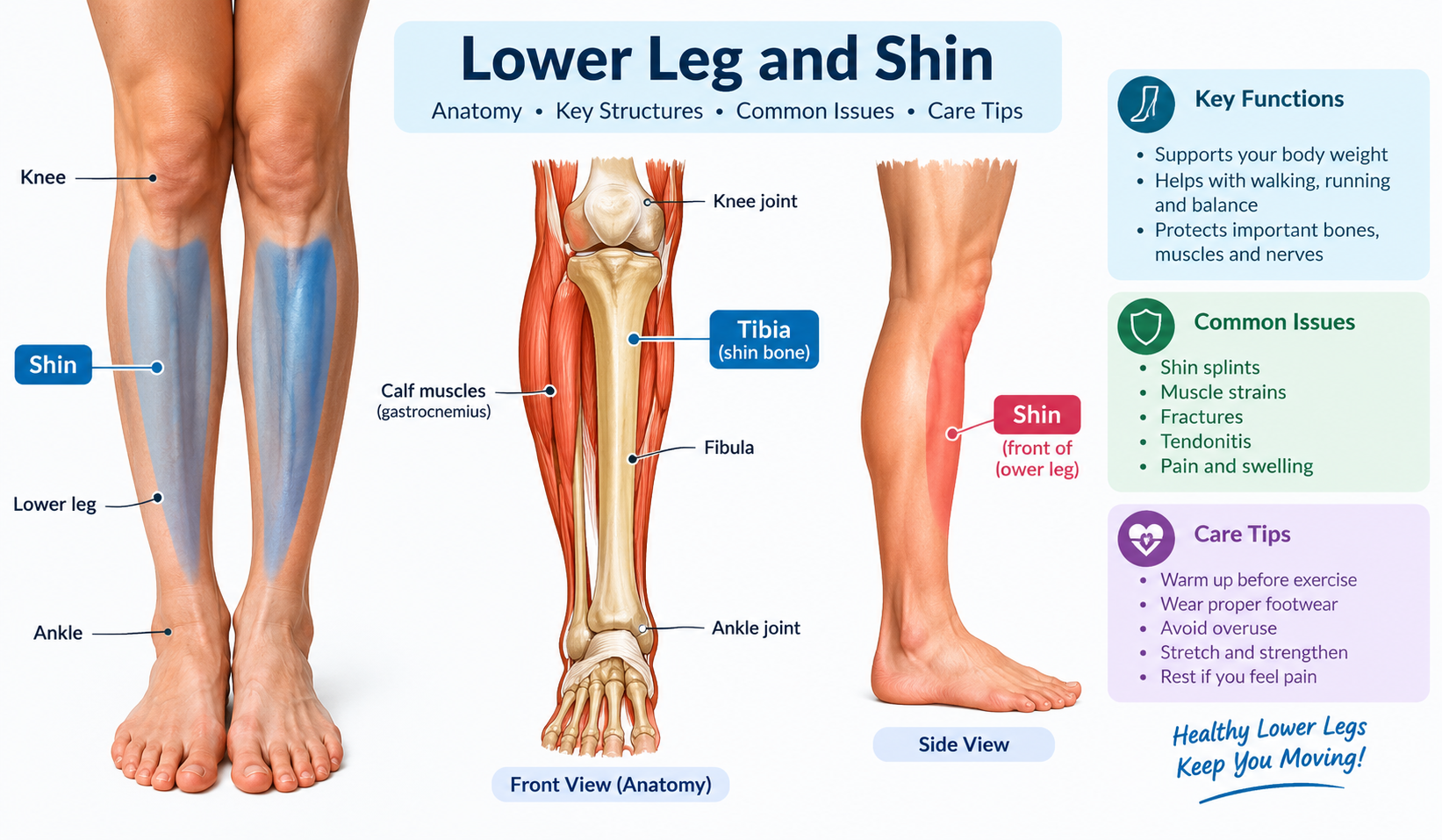
One foot can be visualized as a section of the lower leg, but the exact distance from ankle to knee varies. On a standing person, a 12-inch vertical marker placed near the lower leg will show a small part of the body, not a fixed anatomical landmark. Avoid statements that say one foot always reaches from the floor to a particular point on everyone’s shin.
Hair length
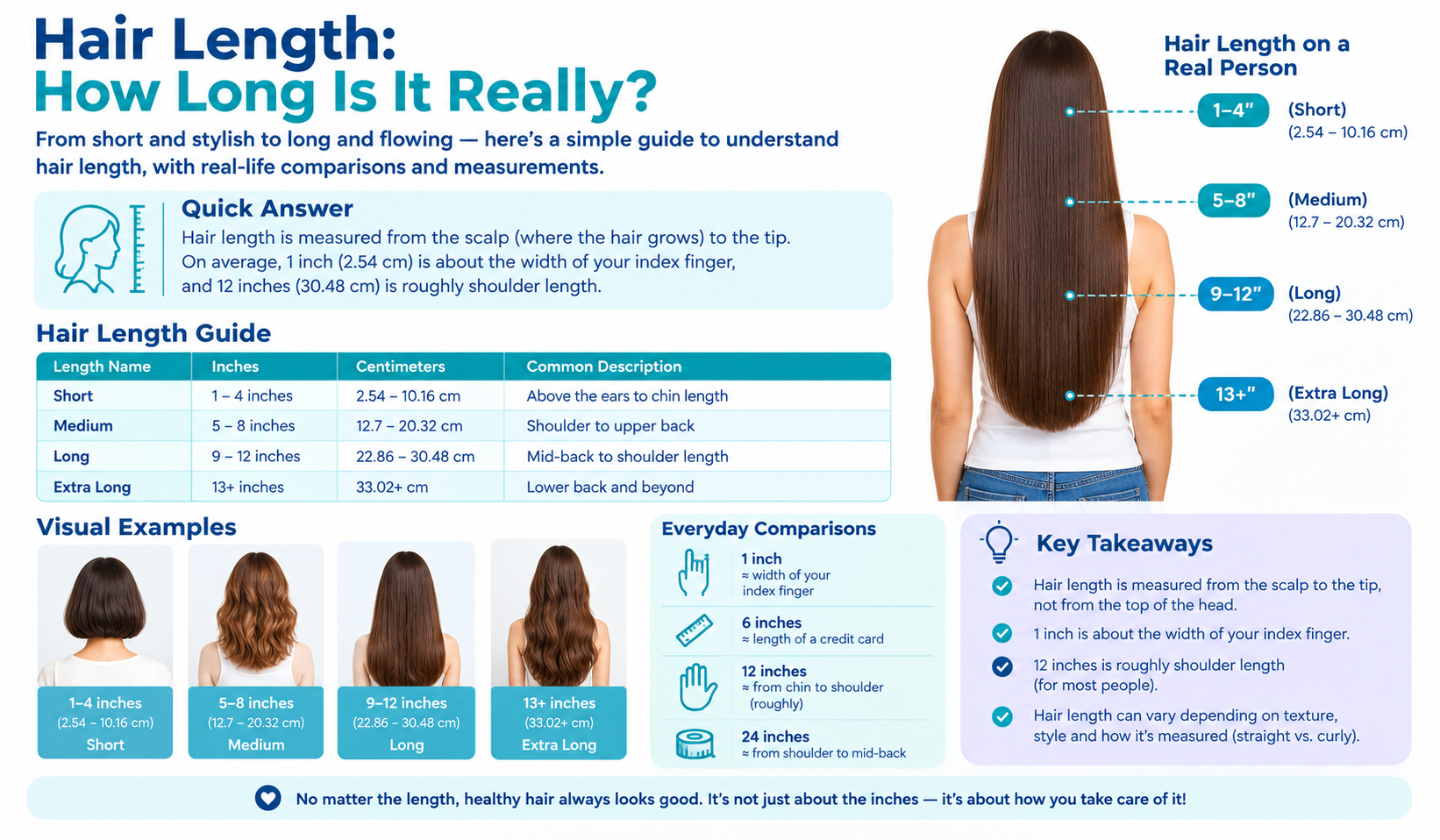
Twelve inches of hair means a strand measures one foot when stretched or laid straight. It does not guarantee a single visible endpoint on every person. Hair texture, curl pattern, shrinkage, the starting point on the head, and whether the strand is measured wet or dry all affect where that length appears.
Body comparison summary
| Body reference | How it relates to 12 inches | What to remember |
| Forearm | May be close to one foot for some adults | Measure wrist crease to elbow tip |
| Hand span | Usually a rougher, shorter single-span reference | Two spans may be close, not exact |
| Foot | Some feet approach a foot in length; many do not | Measure bare foot rather than guessing from shoe size |
| Lower leg | One foot is a visible portion of the lower leg | Landmark differs by person |
| Hair | A 12-inch strand is one foot long | Curl and measuring method change visible length |
Human Height Comparison: Where Does One Foot Reach?
The clearest way to compare 12 inches with human height is to express a person’s height in inches and calculate the fraction. A six-foot person is 72 inches tall, so 12 inches is one-sixth of that height. A five-foot person is 60 inches tall, so 12 inches is one-fifth of that height.
This comparison is more reliable than trying to identify a universal body landmark. People have different leg-to-torso ratios, and two people of the same height may have different limb lengths. The fraction remains accurate as long as the person’s height is measured correctly.
| Example height | Total height in inches | 12 inches as a share of height |
| 4 ft 6 in | 54 in | 22.2% |
| 5 ft 0 in | 60 in | 20% |
| 5 ft 4 in | 64 in | 18.75% |
| 5 ft 6 in | 66 in | 18.2% |
| 5 ft 9 in | 69 in | 17.4% |
| 6 ft 0 in | 72 in | 16.7% |
| 6 ft 4 in | 76 in | 15.8% |
These examples are mathematical comparisons, not claims about average population height. They simply show how a fixed 12-inch length represents a smaller share of a taller person’s total height. To calculate the percentage for any height, divide 12 by the person’s height in inches and multiply by 100.
Is 12 inches a big height difference between two people?
A 12-inch difference in height is visually noticeable in most side-by-side comparisons. For instance, someone who is five feet tall and someone who is six feet tall differ by exactly one foot. Their heads, shoulders, and eye levels will not align, although the precise appearance depends on posture, footwear, and body proportions.
Do not confuse this with saying that a 12-inch object reaches to the same point on every person. A one-foot difference between two people is a comparison of total heights; a one-foot object held against one person is a length. The numbers match, but the visual situations are different.
How to show the comparison in a photo
1. Ask the person to stand naturally against a plain wall, with shoes and posture kept consistent.
2. Place a ruler or measuring tape vertically beside the person and mark 12 inches from the floor.
3. Keep the camera level and far enough away to reduce perspective distortion.
4. Include a visible label stating “12 inches / 1 foot / 30.48 cm.”
5. Do not imply that the marker identifies a fixed anatomical point for everyone.
How to Measure 12 Inches on Your Own Body
A quick body-based estimate is useful when you are checking a rough gap or explaining size to someone. It is not a substitute for a tape measure when accuracy matters. Use the following method to learn whether your forearm is a suitable personal reference.
Method A: Measure your forearm
6. Find a tape measure or ruler and sit or stand comfortably.
7. Place one end at the wrist crease, where the hand meets the forearm.
8. Measure along the forearm to the tip of the elbow, keeping the tape straight rather than following the curve of the skin.
9. Record the result in inches or centimeters.
10. Compare it with 12 inches or 30.48 cm. Note the difference instead of rounding it automatically to one foot.
For example, if your forearm measures 10.75 inches, it is 1.25 inches shorter than 12 inches. If it measures 12.25 inches, it is a quarter-inch longer. Once you know your personal measurement, you can use it as a rough estimate—but remember that changing the start point changes the result.
Method B: Measure your hand span
11. Open one hand comfortably, without forcing the fingers painfully wide.
12. Measure from the tip of the thumb to the tip of the little finger.
13. Repeat the measurement two or three times to check consistency.
14. If one span is, for example, 8 inches, then one and a half spans would total 12 inches mathematically—but lining up your hand repeatedly may introduce gaps or overlap.
This is best used as a mental reference, not as a precision method. Do not use an assumed average hand span in place of measuring your own hand if the result matters.
Method C: Use your foot
Place a sheet of paper on a hard floor, stand with your weight distributed naturally, and trace or mark the heel and longest toe. Measure the distance between the marks. A foot-length estimate is convenient for comparing a gap near the floor, but it is not appropriate for precision carpentry or installing equipment.
| Method | Best for | Main limitation |
| Forearm | Quick personal visual estimate | Can be noticeably shorter or longer than 12 inches |
| Hand span | Rough estimate for small gaps | Hand size and repeat placement vary |
| Foot length | Floor-level visual comparison | Bare foot and shoe dimensions differ |
| Tape measure | Projects, fitting, shopping | Requires a measuring tool but is most dependable |
Everyday Objects That Help Visualize One Foot
Objects can make a measurement easier to imagine because you may already know their size. The key is to separate exact references from items that are only near one foot. A product marketed as “12-inch” may refer to its screen diagonal, diameter, nominal size, or package label rather than its straight-line length.
| Object | How to compare it | Exact or approximate? | Caution |
| 12-inch ruler | Lay it flat from end to end | Exact by stated scale, if accurate | Check where the zero mark begins |
| Tape measure | Extend to the 12-inch mark | Best practical reference | Keep the tape straight |
| 12-inch pizza pan | Measure straight across the circle | Nominally 12 inches | Rim and actual diameter may differ |
| 12-inch vinyl LP | Measure across the center | Nominally 12-inch format | Sleeve is larger than the disc |
| A4 paper | Use the long edge | About 11.7 inches | Close, but not a full foot |
| Two US dollar bills | Place short ends end-to-end along length | About 12.28 inches | Only applies to US banknotes |
| Laptop keyboard | Measure from left to right | Approximate | Model and keyboard layout vary |
| Forearm | Measure wrist crease to elbow tip | Approximate | Personal anatomy varies |
| Footlong sandwich | Check actual end-to-end length | Not guaranteed exact | Food portions can vary |
| 12-inch tile | Measure one side | Exact if tile is sold to that specification | Nominal and installed sizes can differ |
A ruler is the strongest visual reference
A standard 12-inch ruler is particularly useful because the markings show both the overall length and smaller divisions. If the ruler starts at zero, the distance from the zero mark to the 12-inch mark is exactly one foot. The physical ends may extend slightly beyond the scale, so do not always assume the plastic or wooden body begins exactly at zero.
Circular objects: diameter is not circumference
A 12-inch pizza pan or vinyl record is generally described by its diameter: the straight-line distance from one edge through the center to the opposite edge. The distance around the outer edge is the circumference and is much longer—about 37.7 inches for a perfect 12-inch circle. This distinction matters when comparing objects with different shapes.
Paper sizes: close is not exact
A standard A4 sheet measures 210 by 297 millimeters. Its long edge is 29.7 centimeters, or about 11.69 inches, so it is a little shorter than 12 inches. This makes A4 paper a useful visual estimate in many homes and offices, but it should not be described as exactly one foot long.
Technology: check what the size label means
A device sold as a 12-inch tablet or laptop may use the screen’s diagonal measurement rather than the width or height of the entire device. A 12-inch diagonal screen will not be 12 inches wide. Be careful when using product labels to estimate straight-line lengths, particularly when buying a sleeve, shelf, stand, or protective case.
Food and retail products: nominal size can differ
A menu item called a footlong gives you a familiar one-foot concept, but the actual bread can vary in length. Pizza pans are more standardized than food portions, yet manufacturing tolerances and whether a size refers to the cooking surface or outside rim can still matter. Verify the manufacturer’s specification whenever the measurement has to be exact.
Exact Measurement Versus Visual Estimate
There is a big difference between knowing that 12 inches equals one foot and guessing that an object is about a foot long. Conversion math is exact; body comparisons and household examples are not always exact. A useful article should make that difference clear instead of presenting every example as a guaranteed 12-inch object.
| Reference type | Reliability | Recommended use |
| Calibrated ruler or tape | High for everyday tasks | Cutting, fitting, measuring a gap |
| Manufacturer’s technical dimensions | High when the right dimension is specified | Buying parts, devices, furniture |
| Nominal-size household item | Medium | Visualizing general scale |
| Body part | Low to medium | Rough estimate after personal measurement |
| Memory or visual guess | Low | Only when precision does not matter |
How much error is acceptable?
The answer depends on the task. Being off by half an inch may be unimportant when describing the approximate length of a book, but it can matter when fitting a shelf into a tight opening or cutting material. For a visual comparison in an article, an approximate reference is fine as long as it is clearly labeled. For installation, safety, construction, or purchases that must fit, measure the actual item.
If you are estimating without a tool, make the uncertainty visible. Instead of writing “this object is exactly 12 inches,” say “this object is roughly one foot long” unless you have verified the measurement. This small wording choice protects the reader from treating a general example as a specification.
How to calculate the difference
Subtract the object’s measured length from 12 inches. If a paper edge measures 11.69 inches, then 12 − 11.69 = 0.31 inches, so it is about 0.31 inches shorter than one foot. If an item measures 12.28 inches, it is 0.28 inches longer than a foot.
| Measured length | Difference from 12 inches | Interpretation |
| 10 inches | 2 inches shorter | Clearly shorter than one foot |
| 11.5 inches | 0.5 inch shorter | Close visual estimate |
| 11.69 inches | 0.31 inch shorter | Near one foot; A4 long edge example |
| 12 inches | No difference | Exactly one foot |
| 12.28 inches | 0.28 inch longer | Slightly longer than one foot |
| 13 inches | 1 inch longer | One inch beyond a foot |
How to Estimate 12 Inches Without a Ruler
When a ruler is unavailable, choose an object or body reference that you have checked before. Estimation improves when you calibrate it against a known measurement instead of relying on a generic average. If accuracy matters, borrow a measuring tape or use a properly calibrated measuring tool.
Quick estimation options
· Use your measured forearm if you know it is close to one foot.
· Place two US dollar bills lengthwise end-to-end for a result of about 12.28 inches.
· Use the long edge of A4 paper as a near-foot reference, remembering it is about 11.69 inches.
· Use a 12-inch ruler, pizza pan, or tile only after confirming the stated dimension.
· Use a phone’s measurement app as an estimate, not as an unquestioned precision tool.
Avoid stacking items with unknown dimensions and then assuming the total is exact. For instance, paperclips vary in length, and business cards have different formats around the world. A stack or row can be a memorable demonstration, but it becomes reliable only when the individual pieces are measured.
A quick no-tool method for everyday situations
15. Pick a familiar reference: your forearm, a sheet of paper, or a known object.
16. Place the reference beside the gap or object, keeping both aligned at the same starting point.
17. Mark the endpoint mentally or with a removable note.
18. If the estimate will affect a purchase, cut, or installation, verify it with a proper measuring tool.
This approach is suitable for a quick mental picture, not for medical measurement, building code compliance, or any situation where a small error could cause harm. Measurement apps and body-based tricks can be helpful, but their accuracy depends on technique, calibration, and the environment.
Practical Uses of a 12-Inch Comparison
Shopping online
A one-foot reference helps you picture a shelf, bag, cutting board, storage box, tablet, or decorative object before ordering it. Read the full dimension listing and check which side measures 12 inches. Product photos can distort size because of camera angle, perspective, and the absence of a familiar object beside the item.
When shopping, look for dimensions written as length × width × height, and confirm the unit. A product described as 12 inches tall may have a much smaller width. If the listing gives only screen size or diagonal size, look for the full device dimensions before choosing an accessory.
Home improvement and DIY
One foot is a common planning increment in shelves, boards, storage spaces, and home layouts. A visual comparison can help you estimate whether an object is roughly the right scale, but you should measure the actual opening and account for hardware, clearance, trim, and installation tolerances.
When marking wood or other materials, use a straight ruler or tape measure and mark the zero point correctly. Do not rely on your forearm to make cuts. If the material will be load-bearing, follow the design specifications and appropriate safety practices.
School projects and teaching
Twelve inches is an easy way to introduce measurement conversions because one foot equals 12 inches and 30.48 centimeters. Students can compare a ruler, paper, and hand span, then record the results in a table. The learning goal is to distinguish an estimate from a measured value, not to assume every student has the same body dimensions.
A classroom activity can ask students to estimate one foot, measure it with a ruler, and calculate the difference. This turns an intuitive visual question into a practical lesson about units, precision, and error.
Crafts, sewing, and art
A foot-long reference is useful when cutting ribbon, laying out a small craft, or estimating the size of a drawing. However, fabric can stretch, curl, or fold, and a flexible material should be measured without pulling it too tightly. For sewing, follow the pattern’s units and seam allowances.
Explaining size in photos and articles
If you publish an image comparing 12 inches with a human, make the ruler and measurement arrows easy to read. Use the same starting point for both the ruler and the body marker, and label whether the arrow indicates height, length, diameter, or width. A perspective-heavy photograph can make a measurement look longer or shorter than it is.
| Use case | Useful comparison | When to verify |
| Online shopping | Ruler beside product or dimension diagram | Before ordering a close-fit item |
| Furniture layout | One-foot floor marker | Before drilling, cutting, or installation |
| Classroom activity | Ruler and personal body estimates | When recording final results |
| Crafts | Ruler or cutting mat grid | Before trimming expensive material |
| Visual article | Clearly labeled ruler graphic | Before publishing numeric claims |
Common Mistakes, Do’s, and Don’ts
Common mistakes
· Treating every adult forearm as exactly 12 inches.
· Assuming a shoe size is the same as foot length in inches.
· Calling an A4 sheet exactly one foot long when its long edge is about 11.69 inches.
· Confusing a circular object’s diameter with the distance around its edge.
· Assuming a 12-inch screen label means the device is 12 inches wide.
· Using an unverified household object for a precise cut or tight fit.
· Describing a 12-inch marker as reaching the same anatomical point on every person.
Do’s
· Use the exact conversion: 12 inches = 1 foot = 30.48 centimeters.
· Label body comparisons as approximate and measure your own body if using it as a reference.
· Use a ruler or tape measure when accuracy matters.
· Check whether a product dimension is length, width, height, diameter, or diagonal.
· Use consistent start and end points when measuring.
· Include units beside every number so readers do not confuse inches with centimeters.
Don’ts
· Do not claim a universal human body measurement without a credible source.
· Do not imply that a common product is exactly 12 inches unless its specification supports that claim.
· Do not rely on a visual estimate for safety-critical or tight-tolerance work.
· Do not use an illustration as evidence of a population average.
· Do not keyword-stuff “12 inches compared to human” into every heading or paragraph.
The simplest rule is to match the level of certainty to the evidence. State exact unit conversions as facts; describe anatomy and everyday objects as approximate unless directly measured or specified by a reliable manufacturer.
Frequently Asked Questions
How long is 12 inches compared to a human?
Twelve inches is one foot, or 30.48 centimeters. It is roughly the length of some adults’ forearms, but the exact comparison depends on the person.
What body part is about 12 inches long?
A forearm measured from the wrist crease to the tip of the elbow may be close to 12 inches for some adults.
Is 12 inches the same as one foot?
Yes. Twelve inches equals exactly one foot by definition.
How many centimeters is 12 inches?
Twelve inches equals 30.48 centimeters, because one inch is exactly 2.54 centimeters.
Is 12 inches a lot compared with human height?
It is a relatively small part of an adult’s full height. For a person who is six feet tall, 12 inches represents one-sixth, or about 16.7%, of total height.
How can I measure 12 inches without a ruler?
Use a body reference you have measured before, such as your forearm, or compare the length with a familiar item whose dimensions you know.
Is an A4 sheet of paper 12 inches long?
No. The long edge of A4 paper is 297 millimeters, or about 11.69 inches. It is close to one foot but slightly shorter.
Does a 12-inch tablet measure 12 inches wide?
Not necessarily. Tablet and laptop screen sizes are usually measured diagonally across the display. The width and height of the whole device are different dimensions.
Conclusion
When you think about 12 inches compared to a human, picture a one-foot length beside a person—not a person who is one foot tall. Twelve inches equals exactly 1 foot or 30.48 centimeters. It may resemble the length of your forearm, but your own body measurement is the only way to know how close that comparison is for you.
For quick visualization, use a standard ruler, a verified product dimension, or a personal reference you have measured. For projects where fit and accuracy matter, skip the guess and use a tape measure. That combination—a clear visual example plus an exact conversion—makes one foot easy to understand without overstating what body proportions can tell you.

Ezra Holden is a measurement focused writer at Classy Valve, sharing practical insights on units, dimensions, conversions, calculations, and measurement concepts. With a research driven approach, Ezra focuses on clear explanations, accurate examples, and useful guidance that helps readers understand technical measurement topics with greater confidence.